 |
Review Gaston Bachelard - The Freedom of Symbolism. The Metaphor of Dreaming
La reverie est un univers en emanation.
Gaston Bachelard
Premise
The art of Mimmo Petrella, is a journey that as gone on for over forty years and beyond his art studio, and it
quickly appears to balance between two extremes: one being a strong ï metaphorical tension in abstract informal
work, and the other pushes towards visionary work, characterized by strong abstract and experimental
marks which are made by different painting techniques that are chromatic and materico and are derived by
project work that is often inspired by what supports and inspires the work of art being made. In places where
the campano artist has his work you can see a dense influence of imagination and fantasy, inspired by a sort
of visual and sensitive nature.
Sensitivity is effectively one of the beginning points of his artistic journey, but this sensitivity is not necessarily
sensual. Although, there is evidence of sensuality in his work and it is a key foundation of his work. The perception
of his art is conceived as very sensitive and like an expansion of human instincts and feelings and is implicit
to his style while it is being created. In fact, Petrella as altered traditional painting, a performance, a collage
by multiplying interferences in space and nature. In other words, his artistic style in its variation of study
reveals a metaphorical tension that emulates and manipulates its form and the chromatic media with an intimate
adhesion of sound and vision while it expresses an urgent vivid expression with instinct and vision.
Gradual tension has slowly surpassed the unrecognizable spaces which have provided a figurative support and
have characterized the foreground of his art or of a metaphorical animal with Baconian characteristics that
liberate it from years of intense colour in a dense inspirational expression of media. With everything gone, it
doesn’t leave an abstract element, but integrates strong spiritual aspects in a poetic key and yet still visionary.
Definitively, the subjective support which at first was represented by the figure is now substituted by fundamental
use of materials and with an attentive pressing of the art work to the point that the end result is inseparable
from its container. Between the two extremes there are happiness and a big chromatic sensibility. The
mix of media gives Petrella a base for inner discussion, but never purely emotional: a wide, rigorous material
that is also smooth, with broken threads, and is capable of giving a splash effect by brushing patiently and
impatiently on a plane full of energy and dynamics.
When in comparison to the master’s of the Campania and Meridional Art of today, Petrella is definitely one of
the most independent artist; although his work possesses a great configuration it surpasses the primitive conflation
of an Expressionist and this is the source of his informal study. In Naples however, this study has pro-
gressed with a more intent thought (Spinesi, Biasi, Stefanucci etc.) in which the majority of these artists have been
preoccupied with collecting the limitation between both visible and invisible which has characterized much of the
Post-War Abstract Art. Petrella has always been an independent artist and not only because of his closed and
reserved character, but because he always goes by his personal intuition instead of emulating great artists of his
region. If he should surpass his artistic expectations by emulating a more historic suggestion like the informal
work of De Kooning and friends he has purely and freely confined with loose brush stroking techniques.
The Beginning and Anguish of Post-Cubist Art
The first art works of the end of the 1960’s are characterized by having a strong psychological influence. These
works depict an arrangement of large Post-Cubist figures that are in a strong contrasting state and use a ray of
light to dramatize and to accent the profile of the body of work. Essentially, the feminine form is used to exalt sensuality
and is immersed in an almost surreal state of anguish. Even the colour reflects this psychological condition
where there is a pang of flesh that is completely internal, reflective and the centrefold of the piece. In to
Liberazione femminile in 1970, in larger dimensions the feminine figure symbolizes a dual tension of the body:
the first being a form that is almost sculptured with a strong contrast from light to dark; while the second is more
attentive to light and has facets intertwined through the foreground of the face. If you look closely you can see an
expedient double vision with the first underlining the formal and the second representing tone. However, both
visions are intertwined with a look or style of monumental figures that have anguish and incumbent characteristics
as if they were in a dramatic dream. This period is characterized by a series of paintings that have the same
register and reflect an androgynous form, a rushed form and is even spacious and is marked by mysterious
restlessness. Assorted figures almost animal, almost monstrous folded on themselves on a compact and indefinite
foreground without any connation to placement or time. The clash of these assorted figures is emotional and
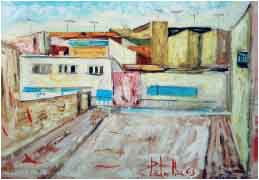
notable. The surreal climate was already present in his previous works like Acerra da via Zara, which is an oil
painting from 1965 (Petrella was 17 years old at the time); in which a foreshortening group of houses are on an
oblique and deserted courtyard that characterize the emptiness of the image and even have the same chromatic
environment. The visionary and imaginary tension assumes various experiments. The artist uses a mixed technique,
a sort of collage technique mixed with paint and an assortment of different materials like rigorous mixtures
that align prospective spaces where figures emerge with a mysterious pang of inner anguish. The climate is generally
pensive and space is marked by a schematic of colour.
A change happens in 1977. Petrella just under the age of thirty is left fascinated by the Neapolitan master
Woschimps exhibit and by his Anthropomorphism which anticipates a realization of a lucid detachment and as a
sort of custodian of horror. Inspired by this adhesion, in a Baconian register in which he fabricates a series of
paintings with a fluid material that is sensually decomposed and about to dissolve. The subjects are generally
dead lambs that have been butchered like something you would see at a butcher shop, but here they are separated
in an indefinite space like marble on a wooden operating table and they appear to express a morbid, cruel
and abandoned death without hope. The chromatics are livid, variegated and stop a little on the transparency of
the plane, they render the idea of the meat being intertwined in the structure of the piece. Meanwhile, it nurtures
itself with a strong realistic illusion and surpasses the silence of the form without life and without a soul.
The Mated Form
A drastic change happens after a year or so. We are now in the year 1982. Up and till the end of the late seventies
the visionary dimension of Petrella’s art was nurtured by a sensuality that was aggressive and plastic in
nature, and was understood by its hardness and crude form. With this a distance was brought close. Now with
an overturn of spirituality and an optical cone it nurtures itself by unexpected spaces of silence and by areas of
suspended time. Thus begins with a parallel period of informal research of the alated form which characterized
his artistic production for five years. in single geometric spaces that delimit like multiple reflection of mirrors in
a fantastical open-closed curtain fashion using movement of silent and light-hearted non-human figures. There
are spaces of uniformed colour which are freed in improbable skies and cross surreal environments. They are
forms that have no weight and are often hand drawn and cross planes that are oval and layered. Physically the
figure looks vaguely like the human form, but nothing characterizes it has so. They are forms without sexual
organs that until now were
assembled into groups or isolated themselves in mysterious flights. The climate is full of suspense and with surreal
travel into time and there are windows of empty space that multiply into enigmatic absolute prospects that
are not proportioned. Although, these windows don’t go beyond a radical change there always exists a threshold
that goes from here to beyond in Petrella’s work.
If the chromatics of this art work gives a cold visual impact, in general swinging between blue and gray then the
other colours characterize a more warm tone. The figure assumes a complex physiognomy while recovering a
fantastic point of view which was previously in the form of anthropomorphism. On the other side of the artwork
an illusionistic effect is lost and elegant shading appears that crosses the entire piece with a playful internal and
mysterious mirror effect. That which has moved people in these few years is the elegance of his style which is not
conformed, but instead follows both the psychological and emotional characterization of the dynamics of the figure.
Then he returns to a more organic corporeal imagine that superposes a lightness and pureness of style
The formal attention acquires a rare equilibrium. This is a happy moment for Petrella’s art in which the metamorphic
tension is essentially descriptive and miraculously balanced internally in a strong surreal space of characterization.
Thus period of equilibrium encounters a moment of extreme synthesis in his immediate work and
then the artist abandons every figurative reference. He then begins to experiment with informal abstract art
which is marked by strong contrasting tones that vary in colour and are a complex of intertwining marks of light
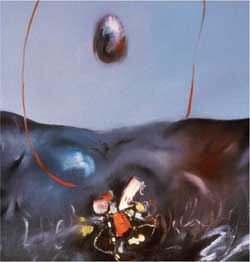
and rarefying background. In //surrealism? ritorna, Petrella elaborates on his more congenial pieces, those of
universal surrealism and those of subconscious that interpret temporary suspension using artificial symbolism
that give a cinematic impact. In the foreground there is a figure that is cushion like and painted in a deep and bright
uniform fashion and looks as though one were passing a diffused light that comes from below. On the cushion
like figure there are chromatic marks like coloured stones and above it in correspondence to this figure there is
an oval form suspended in air and around it is a mysterious red string.
The House of Wind
We are now mentioning the art pieces of the mid-eighties. He slowly builds the materico dynamics in a way which
colour becomes his signature style. A style that is vibrant, strong, and made up of paste mixtures that don’t outline
the profile of a form, but outline the body and follow the movement of emotions. With a knowing contradiction
of light and dark tones and with warm and cold tonality there is a playful game of light and dark backgrounds
and foregrounds that represent an internal and informal tension. This use of tonality is open to a visionary
outlook which uses experimentation that allows the artist to create pieces that convey a strong emotional impact
with metaphorical connation. It seems that in the last few years the artist has recuperated all his inspirational
tension that has characterized his previous works. These tensions include the force of chromatic impact, impulsive
and powerful tension, the metamorphic push, the surreal suggestion, the significance of form in terms of
signal-expressive, fantasy atmosphere, and the indecisive. Some of his pieces are very beautiful like Minotauro of
1984 and the series of pieces entitled Pittura intensa of 1985. The artist conveys a great power over colour and
symbolism and uses a strong brightness which is a rare interpretation of both visionary and fantastic work.
What follows is essentially a style that consolidates abstract and informal tension into an allusive reality. This is
a dense period of experimentation. The artist travels between Caserta where he has an art studio in via
Mazzocchi, which is on the last floor of an old building in the centre of the city that faces the Caserta Palace to a
shed he built in the countryside of Acerra. This location in the countryside provides the inspiration for various
pieces depicting nature and the environment around him which he will entitle “Casa del vento”.
Performance and Informal connection
It’s an art piece from 1986-88 which seems emblematic for this period of new informal work and it doesn’t leave
out the past figurative technique. Nudo 2 from 1986-87 is done in an elegant form which occupies every dark
space of the work. In reality nothing can compare to a feminine form. Even his shading which is wavy, curvy and
hill like is marked by enamel and by a vibrant colour scheme that recalls an intimate sensual suggestion. Crosshatched
linear strokes give a uniformed and a splendid touch to the lightness of the work.
Starting from this work of art there are strong marks of Expressionism in a complete abstract manner that outline
the vibrate sense of the work with a magma red and okra colour, which clearly connect with the strong emotions
put into the piece. This is the most informal period of Petrella’s work. His informal nature resonates entirely
in his creativity and his passion for his work. Also, his visionary abstract work is in bright visual context in
which the brightness of the colour is unified with the texture of the material. The chromatic marks are frequently
bristled and even smooth and they depend on the brush strokes of the artist and his inspirational vision. A period
in which Petrella takes to his informal technique is when he was with his close friend Orazio Faraone, who died
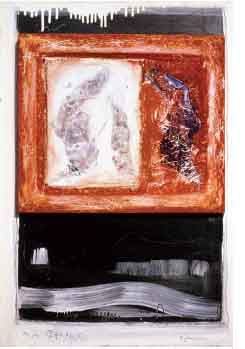
prematurely. Petrella was very close to this artist because they reproduced many art pieces together. In simmetria
is dated 1986. In this piece there are two square forms that have been inserted and integrated in a rectangular
plane that is bright red and variegated and it reproduces a converging tension in the dark lower part of the
background of the piece. This piece also symbolizes a dynamic and transparent tone that gives a continuing element
to the piece and outlines the lost of a friendship and of art.
20
This is the age of the first open performance. On his land in Acerra his works are inspired by the local cultivation
of citrus fruits. This inspiration is a sign of expansion and the need to feel like an artist that can integrate with
his space and surrounding environment. His mentality is the concentration of everything you see, do, feel, hear,
and touch in nature integrated into his work and is also a playful reflecting game that is both psychological and
has an emotional permeability.
Also during this period he has reverted back to informal work. Omaggio cobra is a panel of thirty small mosaic
pieces exemplified in a rational way and are purely a multifaceted expression. In this creative expansion there is
an internal description of itself that is a sort of a volunteer identification of gesture to form and form to colour.
Also during this period Petrella’s work captivates your attention because of its intense texture and by the sensitive
energy that is transmitted into the image he is trying to create. In doing so, Petrella’s work reads as a personal
diary of his life.
It would be really interesting to elaborate on the psychological dimensions of his art and to make references to
the deep relationships that reveal the artist while at the same moment the spectator reflects and relates to the
work and its unifying message. This same wondering nature is present in the artist’s style and in the temporary
change of language. These techniques are psychological and reflect a sensibility that expands with the media used
by the artist. Those techniques also coincide with Petrella’s creativity, but also convey instants of depth and symbolize
revelation within revelation in a mysterious sub-terrain fashion while conjugating the visual and nonvisual.
This is a complex discussion that could take us far.
The Apparizioni of 1990 is also particular interesting. On planes substantially monochromatic the artist puts
marks that appear as wounds with irregular borders and openings that appear as a lower universe of brilliant
colours with variegation. The works captivate its audience because it is characterized as having an extremely formal
equilibrium. In reality, the solution the artist frequently likes to use in his work is visual and metaphoric and
it appears to acquire an inner value. This seems to establish two separate visuals, one external and one more
internal and both are visible in the narrow cracks of the shading.
A single bracket, which is a testimony of the graphic skill of the artist is the work Omaggio ad Acerra of 1990. The
artist paginates and organizes four identical silhouettes in which you can recognize the mask of Pucinella and the
emblematic plate of macaroni. The diverse chromatic colour of the background of the silhouettes sends back a different
psychological emphasis. However, the work doesn’t exhaust the simply technical-visual exercise. In fact, it
is the style of the piece that constructs the real fabric of the work and this style is free, expansive, impulsive, and
even brilliant.
During this period his performance art acquires a scenic dimension. The artist produces works that have a strong
chromatic style that disseminate in natural space. He places papers on trees and bushes and photographs them
and at the same time demonstrates a great ability as a photographer. Photography for the artist becomes a precious
integration for his work even to the point that he uses printed images in Ilfochrome or cibachrome that
range from strong to brilliant in a visual emphasis. The most suggestive performances of this period are the pieces
entitled en plein air of 1990. Of these suggestive pieces one is displayed in Belvedere of San Leucio of Caserta.
In the same year there is also Specchio as well as other promising pieces that artist has in the garden of his mythic
country house.
During this period the artist does his first installations. The artist tends to use rows of open spaces on landscapes
and constructs wooden silhouettes that have a strong vertical organization. The esthetical idea that connotes
these works is that of a loophole in the passage of the works. The crossing becomes a sort of obligated course.
The free space between the cracks of the work is occupied in a causal way by floral inserts, bright objects, and
stones variously coloured. This produces a sort of suggestive stumble on the free and visual course while conditioning
and in some way alternating a poetic and fantastic style.
A chapter on its own is the work Cammino verticale which has been variously displayed since 1994 and seems
too implicit a significant existence and the look like the sacred bone. The central wound of the shaded panel is
like an arched window with only one opening and occupies a fragment of cloth, chromatic elements, flowers,
reflective objects, and is mounted on the support of rows of tension that characterize the wound and in some
way sutures the piece. The work provokes your attention by using an evident symbolic significance and you can
feel a strong tension within a glance.
Gothic Prospects
Extraordinarily made in brackets of decorative and abstract that close with the change of the seasons and produce
interesting works like Pittura vibrante of 1991, the artist uses marks that are mobile and unique in style
and uses an undetermined floral allusion impressed on his art. In 1994 the artist makes a decisive change in
style. The artist returns to painting pieces that are instinctual, segnica or informal, chromatic, distinguished by
chromatic p4stes, unique, and variegated, but internally recover a sort of visual prospect by constructing primarily
with supports of wood and made according to the gothic arched windows, but at the same time seem to
allude a gothic sensibility. The shadow of the monofora or arched window is at times multiplied and ordinarily
positioned in a big dimensional panel and in this panel the artist explores many different combinations of style
colour. The works are very interesting. It seems that the background serves as a spiritual prospect and trusts
the order as well as recognizes the geometric marks used in the pieces along with an element of architectural
symbolism and connotations. However, internally this rigorous space was built for functional purposes and
almost in a medieval machine like matter with a style that is not only chromatic, but linear as well and it acquires
a suggestive and surprising mobility. Often the aggressive and intense colours superimpose themselves in a
mirrored game of smooth and harden materials while the finer, lighter, and delicate colours seem to lose themselves
in the arches of the piece and give a poetic reflection. Its Pittura sacra or sacred painting as the artist
defines it and it alludes spirituality of gothic architecture. A surprising aspect of this work is the singularity of
the supports and the mechanical construction of the panels that open like windows and these windows are painted
the same way inside and outside with various chromatic tones as well as with many suggestive, psychological,
and formal drawbacks. The elegance and happiness extracted from the piece amalgamate and strengthen
the intense marks of internal emotion. Vision and psychological and emotional tradition found in the piece
conjoin in a rare elegant visual happiness. These sacred paintings are from ‘94 and ‘95. The form of the window,
bifora or monofora with dual solutions to the machine and its compartments are like open doors that are
internally painted and simply multiply the formal form. They can be utilized allusively in a more pleasing
aspect and allude a space and a spiritual story like in Quadro mobile of 1994. Also, it can be interpreted and
utilized in a more decorative style like the search for a developed form with chromatic aspects that convey great
visual finesse like the paper of 1994 emblematically entitled Ricerca.
The next chapter of Petrella’s art is a testimony to a more inspirational tension which is more dynamic and
much more attentive to the visual structure of the piece. His work varies from pure formal to impulsive experimentation
and always trusts the chromatic media he uses while giving an intense energy and colour to his style
like Pittura su Pittura of 1994. If you analyze the artist’s work you can see that it is based on the supports, surfaces,
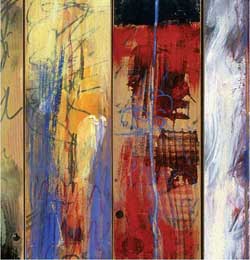
shading, orientation, and composition. Pittura verticale is a list of vertical peaks like a wooden fence.
Every list is a story of marks and visions on light surfaces, visionary backgrounds, and uses light waves of
colour that generally blend an almost break the lightness of the surface. It’s inevitable to recall the memory of
abstract-lyrical paintings of the second Post-War period and also some of the spazialiste solutions or solutions
that use manifests to express their ideas. However, the campano artist interprets this internally in an original
visionary course by using his magmatic fantasy. Also, there isn’t much distance between the alated ghosts that
cross the borders of the work and these ghosts silently become agitated like disturbed surfaces. Then we face
another metaphoric element that will be important for the development of the master’s work: lyrical warning:
with a dimension that’s equally fantastic and like a sort of expansion of creativity gesture that acquires free
space and at the same time aggregates the artistic language surrounding the emblematic figure which is similar
to his work all. That which was the arch of Petrella’s art was light and this light is absorbed in all of his pieces
in the last few years and becomes a visual metaphor that concentrates around the emblematic idea of wings
which is entitled Ala di poeta of 1996.
Poetic Wings
The production of Ali di poeta is one of the happiest moments in Petrella’s art. The artist produces silhouettes of
wings on paper both front and back with extreme liberty of design and with great intuitive and lyrical energy.
The pieces are configured with a narrative drama. In abstract terms, the pieces express courses of linear and
chromatic style that become thicker and refined which are articulated and understood to be courses of strong
emotional impact. Chromatic reds and blacks prevail throughout the piece, but also colours that are less intense
alternate with the brighter ones. Frequently, as characterized in Petrella’s art, there are dense materials that
mature before being spread has layers of refined, light, uniformed, or transparent colours. The artist produces
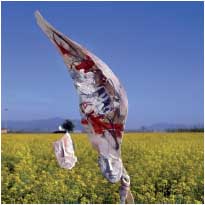
a splendid piece in 1996. In a field, in front of the Castello di Francolise which is a panoramic point and in the
open valleys of Teano the artist contructs metal/cubic figure. The artist hangs wings by a thin and almost invincible
string and arranges them in way that gives the allusion of free movement in space. The pieces read as a
beautiful summer’s day where the silhouettes are free to move in the wind and remain at every instinct a style
of metaphoric suggestion and vivid chromatics.
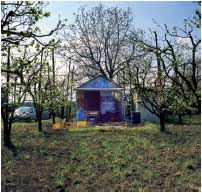
In the same year in Acerra the artist build’s a house/studio in his garden full of fruit trees. The house is in an
area that is very windy and is built with walls that allow discreet air and light to enter, inspiring the artist to
name it Casa del vento or House of wind. The artist installs the wings of his work on the ceiling across the beams
of the house like a cluster of scattered fruit or like a wave of dreams rendering the wings light in space and soul.
This installation is all about making a grand cinematic effect, a great poetic impact, and a metaphoric suggestion.
The theme of Petrella’s winged pieces in the following years is refined and intellectual. Also, the artist re-presents
conceptual works during this period. In these pieces the silhouette produced proves to be lighter and an
example is La sognatrice performance of 1997 which is a chalked profile piece with a naturalistic context.
Otherwise, these pieces can be reduced to composite schemes and forms like All mute e ali anonime of 2001.
During a brief eccentric period Petrella creates a certain number of collages that were inspired by a mariana
review and were promoted by the Diocese of Caserta and Capua. Xe Maria is the title of the elegant collage in
which the figurative form is a transparent background that is almost lightly designed. This is a particular
intense period for Petrella’s work affirmed to a rare and delicate style that is almost untouchable and plays with
the lighting of shading. This is a testimony of Petrella’s art work that goes behind and beyond the energy of his
media and makes it fundamental visionary. Petrella’s fundamentally capable of visualizing and hearing his
work. For quite some time the artist utilized the silhouetted wings as a symbolic object, inserted in open wooden
bulletin boards with backgrounds painted in uniform and variegated colours. The bulletin boards at times
are used to configure structural figures. The research of winged silhouettes occupy the first few years of the millennium
for the artist. The artist even tries to superimpose the silhouettes three-dimensional in which the play
of colours intertwine with the superimpose planes of the work in a singular visual effect like the work Accumulo
d’ali of 2004. The artist even concentrates his attention on the winged silhouette that is no longer supported,
but instead is an independent form that can no longer prescind on the same chromatic plane or on the same
development of design.
We are now at the most recent chapter of Petrella’s art. It’s evident that his paintings follow the same path of
his previous productions: intense colours, expressionism, and mobile and energetic style. However, there is a
more dramatic tension that influences the surface or on the contrary the surfaces of his work. This is because
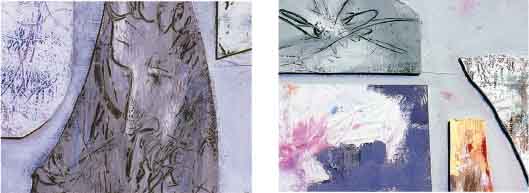
the artist covers a space that is more composed and articulate. The artist produces superimposed papers that
demonstrate a visual play of layers that in the economy of work open a stage of cinematic frames. in thus stated
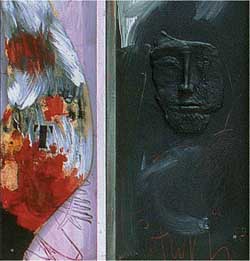
piece, the artist moves scenes and visions that are now vaguely figurative in sights, profiles, faces, looks,
and are totally abstract and on their way to dissolving. The foreground colours are intense, magmatic, full of
light, and use strong tones. This work profiles an idea of a citation of itself as well as history. The citation is like
sediment, a memory, lacerated shadows and shading like fragments recovered in Style 1;Style 2;Lost time and
are preserved and juxtaposed miraculously on the table of the soul. The reports or Ripon/ of 2005, 2006, and
2008 are made with mixed techniques and in general using oil and acrylic paints in which the artist finds his
personal style. Also, the artist finds his rhythm, his inspirations and his incantations of an entire life spent in
the miracle of art.
Giorgio Agnisola |